
House Sinking Signs India — 9 Warnings | Sai House Lifting A house starts sinking when the soil beneath its foundation shifts, compresses, or washes away over time. The most common warning signs are diagonal wall cracks, doors that stick or jam, floors that slope, and ground floors that flood every monsoon. The only permanent fix is professional hydraulic house lifting — a proven process that raises your home safely, repairs the foundation, and eliminates the root cause without any demolition.
Table of Contents
- What Does “House Sinking” Actually Mean?
- 9 Warning Signs Your House Is Sinking
- Why Indian Homes Are Especially at Risk
- House Settling vs. Sinking: Know the Difference
- The Proven Solution: Professional House Lifting
- How the House Lifting Process Works
- House Lifting Cost in India 2025–26
- How to Choose the Right Company
- Frequently Asked Questions
Picture this. You notice a thin crack near your bedroom window. You patch it. The following year, it comes back — slightly wider than before. Your front door starts sticking during the monsoon. Your living room floor feels slightly uneven when you walk across it. You tell yourself it is just the age of the house. You move on.
But underneath your home, the ground is slowly shifting. And every year you wait, the damage grows worse, and the repair bill grows larger.
This is the reality for a large number of older homes across India’s flood-prone regions and alluvial plains. Foundation failure is not sudden — it is slow, silent, and almost always preventable when you catch it early. This guide gives you everything you need to identify the problem, understand why it happens, and take action before your home reaches a crisis point.
What Does “House Sinking Signs India” Actually Mean?
When engineers say a house is sinking, they are referring to foundation settlement. This is a process where the soil beneath a building gradually compresses, shifts, or gets washed away, causing the structure above it to move downward.
This movement is rarely even. Different parts of the foundation sink at different rates. Engineers call this differential settlement, and it is the true cause of most visible damage in Indian homes.
When one corner of your foundation sinks faster than another, the rigid structure above it cracks, twists, and distorts. Doors no longer align with their frames. Floors develop a visible tilt. Walls pull away from the ceiling. Over time, if nothing is done, the structural integrity of the entire building is at risk.
The key insight here is this: your house is not crumbling from the top down. It is shifting from the bottom up. Understanding this changes everything about how you approach the solution.
House Sinking Signs India: 9 Warning Signs Your House Is Sinking
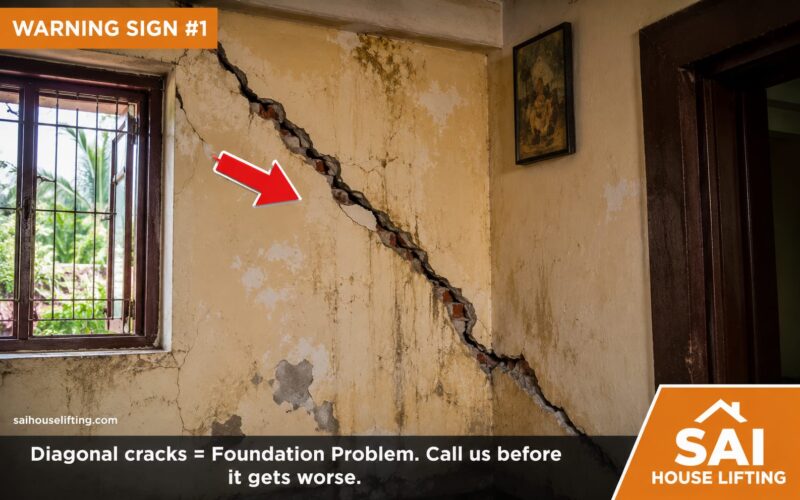
Most homeowners notice individual symptoms without connecting them to a single underlying cause. Here are the nine signs that — taken together or even on their own — demand immediate professional attention.
1. Diagonal Cracks Running from Window and Door Corners
Vertical hairline cracks from paint shrinkage are usually harmless. But diagonal cracks — especially ones running at 45-degree angles from the corners of windows or doors — are a direct structural warning. They mean that one section of your foundation has sunk relative to another, and the wall is being pulled apart along its weakest lines. If these cracks are growing wider over several months, the settlement is active and ongoing.
2. Doors and Windows That Stick, Jam, or Leave Uneven Gaps
Door frames are rectangular. When a foundation shifts unevenly, frames warp and become slightly trapezoidal. Doors that once opened smoothly now stick at the top or drag at the bottom. Windows develop gaps on one side. This happens because the rigid frame has distorted due to foundation movement beneath it. It is one of the earliest and most commonly overlooked warning signs.
3. Floors That Slope, Spring, or Feel Uneven
Here is a simple test: place a marble on your floor and watch what happens. A floor that slopes more than one inch per eight feet is a structural concern. Springy or bouncy sections in the middle of a room indicate that the support structure beneath the floor has weakened or lost contact with its foundation points. Tiles that crack repeatedly in the same location are showing you the line of foundation movement.
4. Recurring Monsoon Flooding on the Ground Floor
If your ground floor floods every rainy season despite repeated drainage work, your floor level may simply be too low relative to the surrounding street level or the local water table. Repeated waterproofing treatments address the symptom, not the cause. House lifting — which permanently raises the floor level above the flood zone — is the only solution that breaks this cycle once and for all. Families who make this shift consistently report it as far more cost-effective than years of annual repairs.
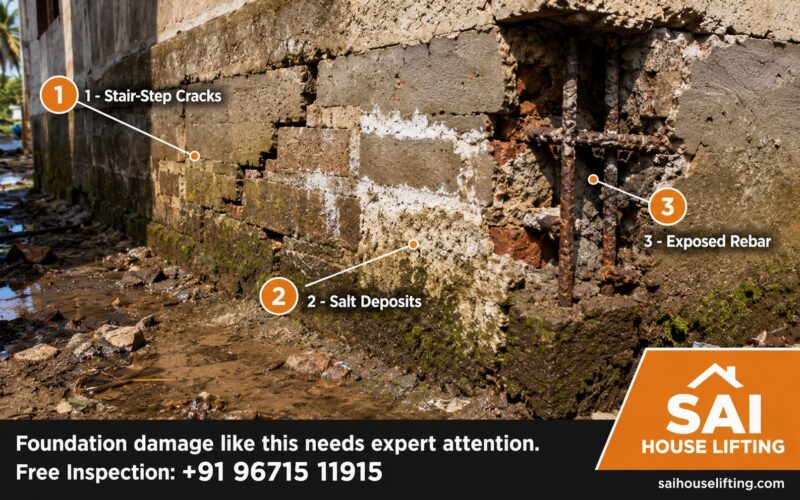
5. Stair-Step Cracks in Brick or Block Walls
In brick or concrete block walls, differential settlement shows up as stair-step cracks that follow the mortar joints in a diagonal pattern. These cracks are structurally significant even when they are narrow. They indicate that sections of the wall are moving in different directions. Left unattended, stair-step cracking widens and eventually compromises the load-bearing capacity of the wall itself.
6. Gaps Between Walls and the Ceiling or Floor
When structural elements such as walls, floors, and ceilings move independently due to foundation shift, gaps open up at their joints. A visible gap between the top of a wall and the ceiling, or between the base of a wall and the floor, means the structure is no longer moving as a single unit. This is particularly serious in load-bearing walls, where such movement can accelerate quickly.
7. Persistent Damp Walls Without Any Visible Leak
Rising damp — where groundwater wicks upward through porous foundation materials — is a direct consequence of the floor being too close to or below the water table. Walls affected by rising damp develop white chalky deposits, paint that blisters and peels, and a persistent musty smell. Mold follows shortly after. This is not a plumbing problem. It is a height problem, and only a structural lift can solve it permanently.
8. Tilting or Leaning Pillars, Columns, or Boundary Walls
Columns and pillars that appear to lean — even slightly — are showing visible evidence of significant foundation movement. Boundary walls that crack and tilt outward are often the first structural element to respond to soil shift, because they have no counterbalancing load on the other side. A leaning pillar is never just cosmetic. It is a load-path problem that can escalate without warning.
9. Cracks in the Foundation or Plinth Beam Itself
If you can see horizontal cracks in exposed foundation concrete or cracking along the plinth beam at ground level, treat it as an emergency. Horizontal cracks in foundation walls indicate lateral soil pressure — a more serious condition than simple vertical settlement. Any visible damage to the foundation structure itself requires professional inspection within days, not months.
“Most Indian families spend between Rs. 4 lakh and Rs. 12 lakh over five to eight years patching the visible symptoms of foundation failure. A single professional house lift — which addresses the root cause — often costs the same or less, and lasts the lifetime of the building.”
Why Indian Homes Are Especially at Risk
India’s geological and climatic diversity creates foundation challenges that few other countries face at the same scale. Knowing your region’s specific risks helps with both early diagnosis and long-term prevention.
Alluvial Plains of the Ganga, Brahmaputra, and Godavari
The plains of northern and eastern India — covering states like Uttar Pradesh, Bihar, West Bengal, and Assam — are built on deep alluvial deposits. While this soil is agriculturally rich, it is also compressible and prone to settlement over time, especially as groundwater levels change with monsoon recharge cycles and seasonal pumping.
Black Cotton Soil in Maharashtra, Madhya Pradesh, and Andhra Pradesh
Expansive black cotton soil swells dramatically when wet and shrinks when dry — sometimes by several centimeters. This repeated cycle of expansion and contraction puts enormous stress on foundations every single monsoon season, progressively weakening them over the years.
Coastal and Flood-Prone Zones
Coastal areas and flood plains across Kerala, Odisha, West Bengal, and Gujarat face both high water tables and periodic flooding. When floodwater saturates the soil beneath a foundation, it temporarily removes the soil’s ability to bear load. After repeated floods, that capacity may not fully recover on its own.
House Settling vs. Sinking: The Difference That Matters
| Factor | Normal Settling | Foundation Sinking |
|---|---|---|
| When it occurs | First 1 to 5 years after construction | Any time, often years later |
| Crack pattern | Minor, stable, hairline cracks | Diagonal, growing, recurring cracks |
| Doors and windows | Unchanged, open and close normally | Sticking, jamming, uneven gaps |
| Floor condition | Level and stable | Sloping, springy tiles are cracking |
| Progression over time | Stops on its own | Gets noticeably worse each year |
| Action required | Cosmetic repair only | Professional inspection immediately |
The Proven Solution: Professional House Lifting
House lifting, also known as structural elevation or hydraulic house raising, is the process of raising an entire building above its current foundation level using synchronized hydraulic jacks. This is not demolition. It is not rebuilding from scratch. It is precision engineering that preserves your home while permanently solving the structural problems beneath it.
For Indian homeowners facing flood risk, foundation settlement, or ground-level problems, house lifting offers something no repair product or drainage upgrade can match — a permanent change to the building’s structural geometry.
Here is what professional house lifting delivers:
- No demolition required — the existing structure is fully preserved
- Works on single-storey and multi-storey buildings
- Suitable for homes, temples, hotels, shops, and commercial buildings
- The foundation is completely repaired or rebuilt during the lift
- Digital monitoring ensures zero tilting or uneven movement
- A legal safety agreement is signed before any work begins
- 100% guarantee and 0% risk when performed by qualified experts
How the House Lifting Process Works — Step by Step

Step 1: Structural Inspection and Engineering Assessment
Qualified structural engineers visit the site and evaluate the soil, the existing foundation condition, the building’s weight distribution, and the lift requirements. Every project plan is custom-designed — no two homes are identical, and a good company will never offer a price or a plan without first seeing the site.
Step 2: Utility Disconnection and Site Preparation
Water, electrical, and gas connections are temporarily and safely disconnected. The perimeter of the building is prepared for steel beam insertion and jack placement. This phase is carried out with minimal disruption to the surrounding property.
Step 3: Steel Beam Installation Beneath the Foundation
Heavy steel beams are carefully inserted beneath the structure at precisely calculated load-bearing points. These beams distribute the full weight of the house evenly across all hydraulic jacks, preventing any single point from taking a disproportionate load.
Step 4: Synchronized Hydraulic Lifting
All jacks are raised simultaneously using digital monitoring systems that measure the elevation at every point to millimeter accuracy. The house rises slowly and evenly. This is the phase that requires the most skill and experience, and it is where the difference between a competent company and an inexperienced one becomes most apparent.
Step 5: Foundation Repair and Rebuilding
With the house safely elevated, the team carries out complete foundation repair — underpinning, new footings, concrete pouring, or whatever engineering solution the site requires. This is the phase that permanently addresses the root cause of every symptom you have observed on the surface.
Step 6: Lowering, Alignment, and Final Certification
The house is gently lowered onto the new foundation. Engineers perform final alignment checks at every corner. A structural safety certificate is issued, utility connections are restored, and the project is complete — typically within seven to fourteen days from the project start date.
House Lifting Cost in India 2025–26
| Cost Factor | Lower Range | Higher Range |
|---|---|---|
| House size | Small, under 800 sq ft | Large, over 2,000 sq ft |
| Lifting height needed | 1 to 2 feet | 4 to 6 feet or more |
| Foundation condition | Minor repair needed | Full rebuild required |
| Soil type | Stable laterite or gravel | Expansive black cotton soil |
| Number of storeys | Single storey | G+2 or higher |
| Typical total cost (residential) | Rs. 300,000 to Rs. 10,00,000 | |

The most important financial point to understand is this: house lifting is not just an expense — it is a cost comparison. The average Indian family that repeatedly patches foundation-related damage over five years spends between Rs. 4 lakh and Rs. 12 lakh on waterproofing, crack repairs, drainage work, and flood damage restoration. A professional house lift, which permanently eliminates the underlying cause, often costs the same or less and requires no repeat expenditure on the structural issue.
Sai House Lifting offers free site inspections and cost estimates before any commitment is made. Call or WhatsApp: +91 96715 11915
How to Choose the Right House Lifting Company in India

Not every company that offers house lifting has the experience or equipment to do it safely. Here is what to look for before you hire anyone:
- The company must have qualified structural engineers on the team — not just laborers with jacks
- Ask to see photographs from previously completed projects of similar structures
- A written legal agreement must be provided before any work begins
- The company should use synchronized hydraulic systems with digital monitoring
- Ask specifically about their experience with your soil type and your region
- Check third-party reviews on platforms like JustDial before making a decision
Sai House Lifting meets every one of these standards. With hundreds of completed projects across India — from residential homes in Madhya Pradesh to multi-storey structures in West Bengal and Delhi-NCR — their team brings both the technology and the hands-on experience to handle projects that many other contractors would not attempt. Every project begins with a signed legal agreement guaranteeing 100% safety and 0% risk to the structure.
Frequently Asked Questions
How do I know if my house is sinking or just settling?
Normal settling produces minor, stable hairline cracks that appear shortly after construction and stop growing. Sinking is progressive — diagonal cracks widen over time, doors stop closing properly, and floors develop a visible slope. If problems are getting worse each monsoon season, your house is sinking and needs a professional assessment right away.
What is the cost of house lifting in India in 2025 and 2026?
House lifting costs in India range from Rs. 30,000 for small targeted repairs to Rs. 10,00,000 or more for full structural lifts with foundation rebuilding. Most standard residential homes fall between Rs. 2 lakh and Rs. 6 lakh, depending on size, soil condition, and the height of the lift required. A free site inspection gives you an accurate figure before any commitment.
Can a house be lifted without being damaged?
Yes — absolutely, when the work is done by experienced professionals using synchronized hydraulic jacks and digital monitoring systems. Sai House Lifting has completed hundreds of projects across India with zero structural damage to any lifted building. A legally binding safety agreement is signed before every single project begins.
How long does house lifting take?
The actual hydraulic lift typically takes one to three days for a standard residential home. Including foundation repair, curing time, alignment verification, and utility reconnection, most projects are fully complete within seven to fourteen days from the project start date.
Is house lifting legal in India?
House lifting is a fully recognized and legal structural engineering process in India. Requirements vary by state — in most cases, a structural engineer’s certification and local authority notification are sufficient. Professional companies manage all compliance paperwork as part of their service.
Can multi-storey buildings be lifted?
Yes. Sai House Lifting works with single-storey and multi-storey residential buildings, as well as commercial complexes, temples, hotels, and institutional structures. Larger buildings require more jacks, more planning, and a larger crew — but the process is equally safe and predictable when carried out by an experienced team.
Do Not Wait for the Next Monsoon to Find Out
The warning signs are there. The question is whether you act on them now or discover the full extent of the problem after another rainy season makes it worse.
Sai House Lifting offers a free site inspection with no obligation. Our structural engineers will visit your home, assess the foundation, identify any risks, and give you an honest recommendation. There is no pressure and no charge for the inspection itself.

We have helped hundreds of families across India protect their homes — and we are ready to help you too.